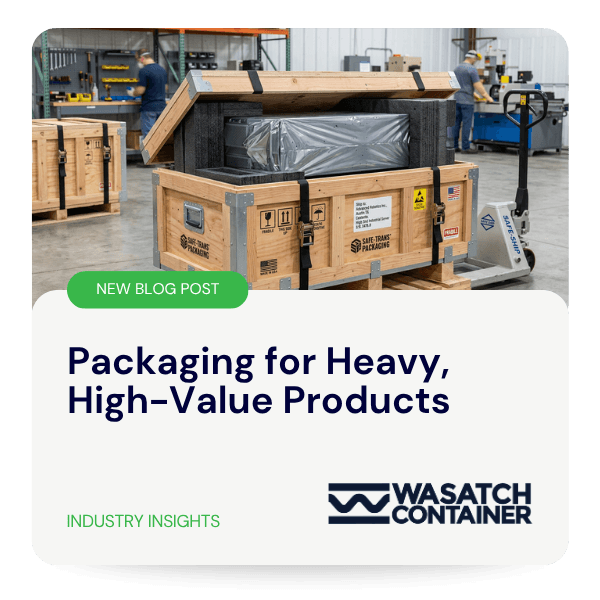
At Wasatch Container, packaging isn’t designed in isolation; it’s built around how products move, are handled, and perform in the real world.
When a local manufacturer began experiencing inconsistencies with their foam packaging, they came to us for support. What initially appeared to be a minor issue quickly revealed a larger disconnect between the packaging and the production process.
By taking a hands-on, performance-driven approach, we developed a solution that improved protection, consistency, and product integrity. Read this case study to see how we identified and solved the issue.
Looking Beyond Specifications
The challenge wasn’t that the packaging failed on paper, it wasn’t aligning with real-world conditions.
To solve the issue, we focused on how the packaging performed in use, not just how it was specified. Packaging today needs to function consistently across every stage of handling, storage, and transit.
We evaluated key factors, including:
- Repeated insertion and removal during handling
- Early-stage compression before shipment
- Foam density relative to product weight and geometry
- Cut tolerances allowing incremental movement over time
In many environments, a small failure rate may be acceptable. But for sensitive, calibrated components, even minor inconsistencies can create significant downstream issues.
A Performance-Driven Solution
It became clear that the issue wasn’t a single failure point, it was a misalignment between packaging design and performance requirements.
We redesigned the foam system to match the demands of the application. The foam geometry was refined to better support critical load points and control movement, while still allowing for efficient handling.
Where additional durability was required, we incorporated reinforced elements to improve structural integrity during repeated use.
We also optimized the foam material itself. By selecting a density better suited to the product’s weight and shape, we improved compression resistance without sacrificing flexibility. This ensured the foam maintained its protective properties throughout the product lifecycle.
Just as importantly, the design was aligned with how the product was actually handled, stored, and shipped, reducing variability and ensuring consistent positioning at every stage.
Validated in Real Conditions
Before full implementation, we tested the solution directly within the customer’s environment. This allowed us to validate performance under real handling conditions and make final adjustments based on actual use, not assumptions.
This hands-on approach ensures the packaging performs exactly as intended once deployed.
The Results
Following implementation, the customer experienced:
- Reduced product movement during handling and transit
- Fewer cosmetic defects and surface imperfections
- Improved consistency across shipments
- Lower rework and scrap rates
In high-performance applications, transit conditions are critical. We’ve developed similar solutions that reduce shock and vibration by up to 50%, helping ensure sensitive products maintain their integrity throughout the shipping cycle.
In many cases, optimized packaging design also leads to measurable operational gains, including up to 15% cost savings and 20% faster turnaround times.
Engineered for Performance
For high-value, precision products, packaging isn’t just about protection, it’s about performance. Even minor movement or impact can affect calibration, quality, and end-use reliability.
This is how we approach every project at Wasatch Container: engineering packaging solutions that protect, stabilize, and perform exactly as required, from initial handling through final delivery.